
|
Electronic Warfare Operations |
|
|
Electronic Warfare Operations |
Strategies and Technologies for Modern Drone Defense Security
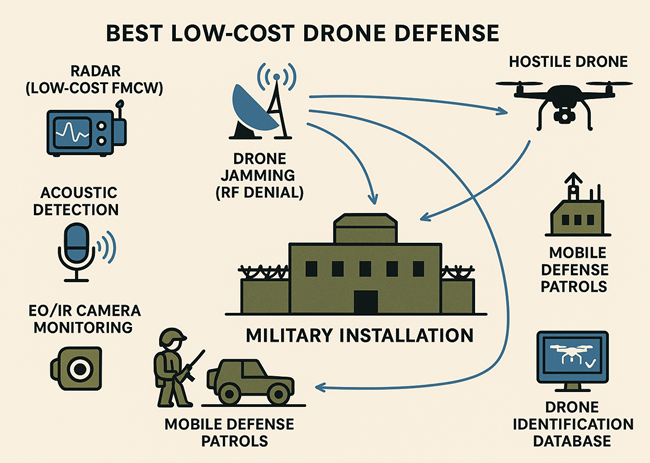
Defending military installations from hostile drones on a low budget requires a layered approach using cost-effective, scalable technologies. The key is to detect, identify, and disrupt drones before they can do harm, using off-the-shelf components and smart integration. Here's a practical and low-cost strategy:
Early Detection with RF Scanners
Technology: Low-cost Software Defined Radios (SDRs) like RTL-SDR or HackRF
Purpose: Detect drone control signals (e.g., 2.4 GHz, 5.8 GHz)
Software: Open-source tools like Kismet, GNURadio, or spectrum analyzers
Advantage: Passive and inexpensive, good for early warning
Acoustic Detection
Tech: Microphone arrays and sound classification AI models
Use Case: Detect distinct drone motor sounds in quiet areas
Tools: Raspberry Pi + MEMS microphones + TensorFlow Lite
Advantage: Works even if RF is silent; low power and portable
EO/IR Camera Monitoring
Setup: Infrared and visible-light cameras on high points
Automation: Use motion tracking and thermal contrast detection
Hardware: FLIR Lepton or low-cost thermal cameras with AI
Advantage: Visual confirmation and tracking, especially useful at night
Radar (Low-Cost FMCW)
Tech: Compact radars like Navtech, 4D Imaging Radar, or TI IWR6843
Use: Detect flying objects, especially non-RF autonomous drones
Advantage: Works regardless of RF silence or audio conditions
Drone Jamming (RF Denial)
Tools: Directional jammers targeting 2.4GHz/5.8GHz/GPS
Caution: Requires legal clearance and safe operation
Advantage: Non-kinetic and scalable for perimeter denial
Mobile Defense Patrols
Setup: UGVs or manned patrols with detection equipment
Gear: Tablet with RF monitor + acoustic alert system
Advantage: Extend perimeter coverage and respond rapidly
Drone Identification Database
Approach: Maintain friendly drone signature records
Tools: Software that logs RF fingerprints or flight behavior
Advantage: Reduces false positives and improves accuracy
|
Component |
Estimated Cost |
|---|---|
|
SDR (HackRF or RTL-SDR) |
$100–300 |
|
Microphone array + Raspberry Pi |
$150 |
|
EO/IR camera (FLIR Lepton + Pi) |
$300–500 |
|
Radar module (TI mmWave) |
$500–1,000 |
|
Handheld jammer |
$500–2,000 |
|
Dashboard server |
$250 |
|
Solar battery & comms |
$400 |
|
Total |
~$2,000–4,000 per sensor node |
Connect with us for a consultation, site survey, or capability demo.
Contact: ewo.info@ewodronedefense.com